
An AI-generated translation lands in someone’s inbox. It arrives in seconds and reads smoothly.
But who decides if it is truly ready to publish?
That question is especially consequential when the content explains a patient’s care or tells a family how to access public services. Someone needs the authority to question the output and stop publication if it needs more work. Organizations adopting AI need to decide who that person is and what they are responsible for.
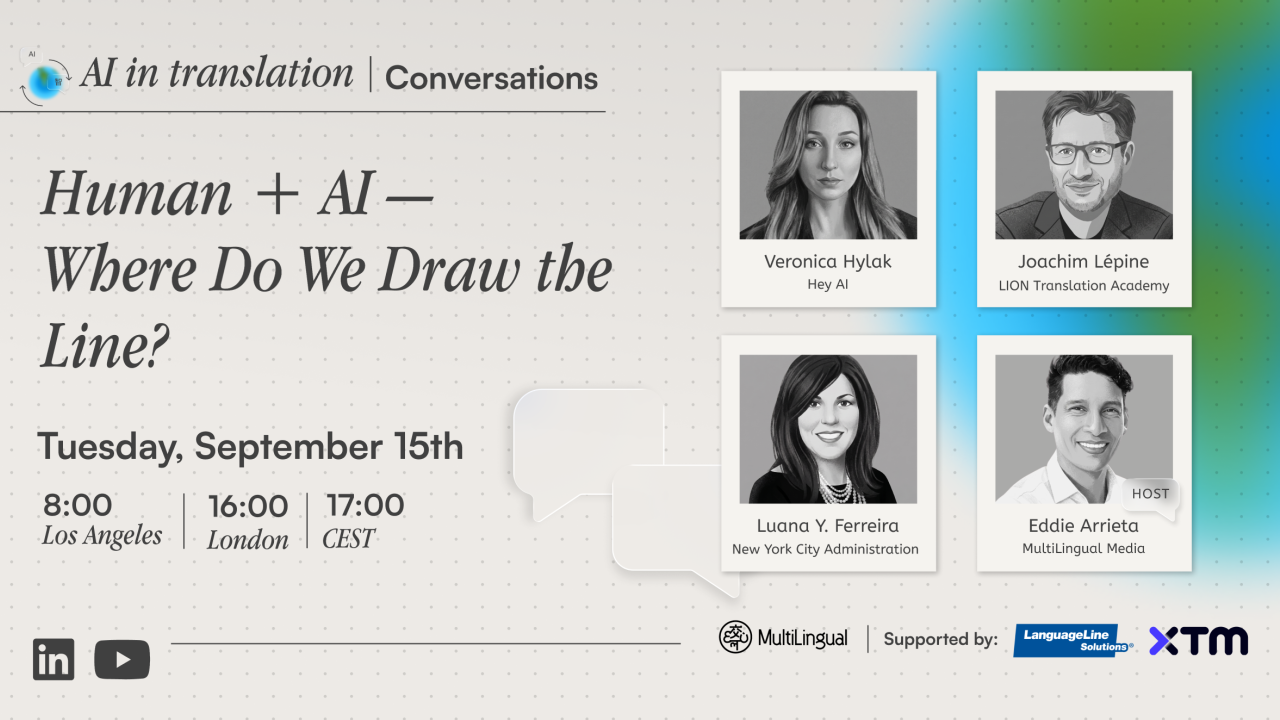
On September 15, 2026, the live webinar “Human + AI — Where Do We Draw the Line?” will explore how to divide responsibility between people and machines as AI takes on more language work.
LanguageLine is proud to support this live Q&A, part of MultiLingual’s AI in Translation Conversations series.
Join us at 8:00 a.m. Los Angeles / 4:00 p.m. London / 5:00 p.m. CEST. Register here.
AI Translation Topics for Discussion
AI can accelerate translation and help organizations make more content available in more languages. Deciding where to use it requires careful thought about the people who will depend on the results.
The panel will explore five conversation topics:
1. Human-in-the-loop vs. human-in-control
“Human oversight” sounds reassuring. Its value depends on what happens in practice.
Does the reviewer have enough time to examine the content carefully? Can they overrule the system’s output, even when doing so delays delivery?
The discussion will examine what meaningful human control looks like as AI systems become more autonomous. A review step on a process chart leaves plenty of questions unanswered, especially about who has the final say.
2. Quality and accountability
A translation can read well and still leave an organization with unresolved questions about responsibility.
Who approves it for use? If an error reaches the public, who is responsible for addressing it?
The panel will explore why evaluating output quality and assigning accountability require separate attention. Organizations need a clear understanding of who stands behind the language they put into the world.
3. Workflows that reflect the risk
An internal draft that a colleague will revise carries different consequences from instructions a patient will take home. Government communications may help someone determine whether they qualify for assistance or understand what is required of them.
Those differences should shape the level of human involvement.
The conversation will examine how the intended audience and potential consequences can guide decisions about automation. The practical question is how to match the review process to the stakes of each assignment.
4. Human judgment, creativity, and cultural competence
A phrase may be technically accurate yet confusing to its intended audience. Creative work may depend on understanding why an expression resonates with one community and falls flat with another.
The panel will consider where human expertise becomes especially valuable as AI handles more routine tasks. That includes recognizing when language needs a different approach to preserve its meaning or connect with the people reading it.
5. Ethics and responsible AI adoption
The ability to automate a task leaves an organization with a decision about whether doing so is appropriate.
Where should the boundaries sit? What circumstances call for human authority, even when automation would be faster?
The discussion will explore how organizations can establish those boundaries with the real-world consequences of multilingual communication in mind.
Bring your questions to the panel
The webinar brings together perspectives from across the language industry and public-sector language access:
- Veronica Hylak, Hey AI
- Joachim Lépine, LION Translation Academy
- Luana Y. Ferreira, NYC Administration for Children’s Services
- Eddie Arrieta, MultiLingual Media, moderator
If your organization is introducing AI into language workflows, consider the decision your team keeps coming back to. Perhaps it is how much review a particular document needs. Perhaps it is who should have the authority to approve AI-generated content.
Bring that question to the live Q&A.
Register for “Human + AI — Where Do We Draw the Line?”
September 15, 2026 | 8:00 a.m. Los Angeles / 4:00 p.m. London / 5:00 p.m. CEST

.jpg)