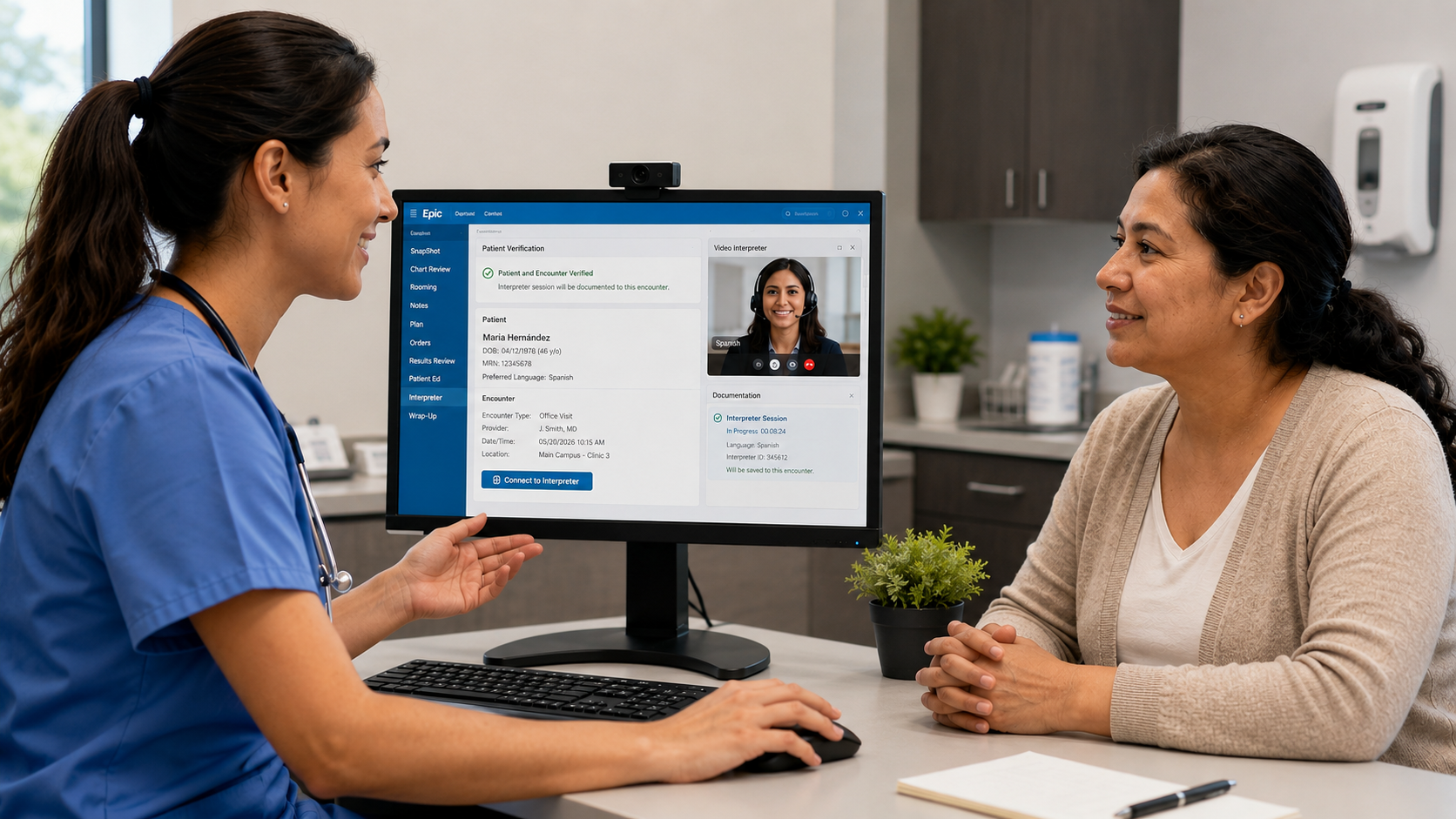
Healthcare Interpreting Services Provide Real-Time Language Access for Patient Care
Support patients, providers, and staff with on-demand interpreting across clinical, virtual, and administrative workflows.
Interpreting Across the Healthcare Care Continuum
In healthcare, language barriers can impact patient understanding, clinical decision-making, safety, and follow-up care. Interpreting provides real-time spoken or signed language support during patient interactions, helping patients, providers, and staff communicate clearly across clinical, virtual, and administrative settings.
Whether through phone, video, or in-person interpreting, or through access embedded within digital workflows, language support plays a critical role in equitable care delivery and regulatory compliance. For a broader overview of how language access supports organizations, explore our complete guide.
100%
Fortune 100 healthcare companies that work with us
16 of 20
Top US hospitals that count on our language expertise
8 of 10
Best children's hospitals are longstanding clients
Find the Right Interpreting Solution for Your Needs
Healthcare communication needs vary across care delivery, operations, and patient access. The solutions below help you quickly identify the right approach based on how interpreting is used in your organization.
Seamless integration of interpreter access into EHR systems and care platforms, enabling efficient, one-click connection to on-demand certified medical interpreters
Manage and optimize in-house interpreter resources
Centralized workforce management that routes requests to internal interpreters first, with direct access to additional LanguageLine interpreters when needed
Support high-volume inbound communication
Interpreter access embedded directly into inbound call workflows through IVR integration, enabling organizations to connect callers to language support quickly and efficiently
Scale language access based on demand
Flexible interpreting access models including pay-as-you-go interpreting and AI-powered options to support both ongoing and intermittent needs
Ensure bilingual staff are qualified to support patient communication
Industry-recognized interpreter testing and training programs help healthcare organizations assess language proficiency, validate interpreter readiness, and support compliance and quality standards for bilingual staff and interpreters.
Choosing the Right Interpreting Modality for Healthcare Interactions
Different healthcare interactions require different types of language support. The appropriate modality depends on urgency, complexity, and whether visual communication is needed.
Over-the-Phone Interpreting (OPI): Audio-only interpreting for high-volume or time-sensitive interactions, such as patient access, scheduling, and contact centers.
Video Interpreting (VRI): Real-time video communication for situations where visual cues support understanding, including clinical consultations and virtual care visits.
In-Person Interpreting: On-site support for complex, sensitive, or high-acuity interactions where direct communication is critical.
Flexible Ways to Access Interpreting
Healthcare organizations use different approaches to access interpreting based on their workflows, volume, and operational needs.
Pay-As-You-Go Access (Credit Card)
Access qualified interpreters as needed without long-term commitments, supporting organizations with intermittent or variable demand.
Integrated Interpreting Within Clinical and Digital Systems
Interpreting can be embedded directly into the systems and workflows used across care delivery—from telehealth platforms to EHR systems and interpreter program management—helping reduce delays and support consistent communication.
Built for Healthcare Compliance and Patient Safety
Accurate communication is essential to patient safety, clinical decision-making, and compliance. As interpreting becomes embedded across clinical, virtual, and operational workflows, ensuring consistent access to qualified interpreters is critical.
LanguageLine supports compliance initiatives through secure workflows and solutions designed to meet language access requirements such as Section 1557.
Improving Patient Outcomes Through Clear Communication
When interpreting is embedded across care delivery, workflows, and communication channels, healthcare organizations can support more accurate patient understanding, reduce delays, and improve consistency in how care is delivered.
By enabling clear communication across languages, organizations are better positioned to support patient safety, strengthen satisfaction, and deliver more equitable care.
Healthcare Interpreting FAQs
Healthcare organizations can access interpreting through a combination of options, including on-demand phone and video interpreting, scheduled in-person interpreting, and access embedded within clinical workflows such as EHR systems.
Interpreting is available through phone, video, and in-person modalities. The appropriate option depends on the urgency, complexity, and whether visual communication is needed.
Phone interpreting is typically used for high-volume or time-sensitive interactions. Video interpreting supports situations where visual communication is helpful, while in-person interpreting is used for complex, sensitive, or high-acuity interactions.
No. Interpreting can be accessed on demand without integration. Integrations are used when organizations want interpreter access embedded directly into clinical or operational workflows.
EHR integration enables one-click access to qualified interpreters within clinical systems, helping reduce delays and maintain efficient workflows during patient interactions.
Talk Through Your Language Access Needs
Every healthcare organization has different communication workflows, volumes, and operational requirements. Understanding how interpreting fits into your environment starts with evaluating where and how language support is needed.