
Audio, Video, or Onsite? A Decision Framework for Modern Language Access
Virtual communication has moved from novelty to norm. What began as a pandemic-era necessity has matured into a preferred way of working, connecting, and receiving care. On-demand interpreting has followed the same arc, and today the question is no longer whether remote interpreting works. It's knowing which format to choose and when.
LanguageLine has been at the forefront of this evolution since our founder, a San Jose police officer, invented on-demand phone interpreting more than 40 years ago. Today we connect people to professional interpreters in more than 240 languages via audio, video, and in-person.
The core principle guiding every modality decision remains the same: let the situation dictate the format, not the other way around.
When Face-to-Face Interpreting Is the Right Choice
Some conversations demand a physical presence. Onsite interpreting remains the gold standard for high-stakes, complex, and emotionally sensitive interactions, including informed consent discussions, new or serious diagnoses, end-of-life conversations, mental health sessions, and legal proceedings such as depositions or testimony-heavy hearings.
Onsite interpreting is also the preferred choice when:
- Multiple participants are speaking and turn-taking is unstructured
- The individual has a secondary disability, such as limited vision, that makes technology difficult to use
- Interpreter continuity over time is critical to the relationship
- Young children or individuals with limited language development are involved
- The law or regulation specifically requires in-person language access
When technology cannot guarantee adequate bandwidth, privacy, or camera quality, onsite interpreting is always the appropriate fallback.
When Video Interpreting Fits Best
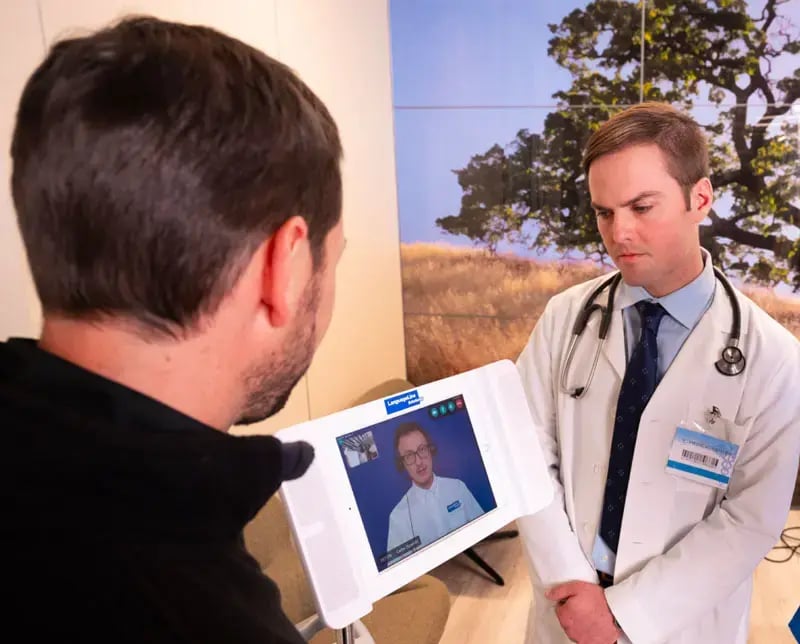
Video remote interpreting (VRI) bridges the gap between the immediacy of on-demand and the visual richness of in-person. At the press of a button, a professional interpreter appears on screen within seconds, able to read facial expressions, provide sign language interpretation, and offer the kind of eye contact that builds trust in a difficult moment.
VRI is well suited for:
- Medical and telehealth visits where visual cues matter
- American Sign Language and British Sign Language users
- Behavioral health contexts where seeing the interpreter adds meaningful value
- Schools, government agencies, retail locations, and field teams including first responders
- Short court hearings in jurisdictions that permit it
One important operational note: VRI works well when the environment supports it. Adequate bandwidth, proper camera framing, good lighting, and a private setting are all requirements, not suggestions. Regulatory frameworks including Section 1557 meaningful-access standards may impose specific VRI requirements, and if a site cannot meet them, onsite interpreting should be arranged instead.
LanguageLine provides video interpreting in nearly 50 languages, including American Sign Language and British Sign Language, with no travel costs and no two-hour minimums.
When Over-the-Phone Interpreting Is the Right Call
Over-the-phone interpreting (OPI) remains the fastest, most widely available, and most cost-efficient option for interactions that do not rely on visual information. It is available in more than 240 languages, making it the only practical choice for many less commonly spoken languages that cannot be served by video or onsite coverage.
OPI is ideal for:
- Appointment scheduling and follow-up calls
- Routine customer service and triage conversations
- Any interaction where meaning does not depend on gesture, facial expression, or lip-reading
- Organizations serving linguistically diverse populations who need broad language coverage quickly
A Quick Decision Framework
Not sure which format to use? Run through these questions:
- Does seeing the speaker matter? If yes, choose video or onsite. If no, phone may be sufficient.
- Is this a sign language request? Video is preferred; onsite for lengthy or complex sessions.
- How long, complex, or sensitive is the interaction? Short and straightforward points toward phone or video. Long, complex, or emotionally sensitive points toward onsite.
- Are there legal or regulatory requirements? Confirm the site meets applicable standards before defaulting to remote options.
- Is the technology reliable and the environment private? If not, choose onsite.
LanguageLine Covers Every Situation
No single modality is right for every moment. What matters is having access to all three, backed by interpreters who are professional, trained, and available around the clock.
LanguageLine provides 360 degrees of language access coverage: on-demand audio and video interpreting in more than 240 languages, onsite interpreting, and written translation and localization services, all available 24 hours a day, seven days a week, 365 days a year.
To learn more, visit our website or call 800-752-6096.