

When the World Cup arrives in North America this week, host cities and transportation hubs will absorb a surge of international visitors unlike anything in recent memory. The tournament runs from June 11 to July 19, spanning 16 host cities across the United States, Canada, and Mexico, and drawing fans from dozens of countries who will speak just as many languages.
For airports, that means a sharp spike in travelers who need help navigating terminals, customs, and ground transportation, often in a language other than English.
The pressure does not fall evenly. It concentrates where travelers first arrive and where confusion carries the highest stakes: passport control, baggage claim, transit connections, and the information desk where a lost or anxious visitor turns for help.
Vancouver International Airport has faced this challenge before.
Olympic Experience
Vancouver is among the World Cup host cities. It is no stranger to international events, as it hosted the Winter Olympic Games in 2010. The event drew over 500,000 spectators from outside Canada's borders, as well as roughly 2,600 athletes and team officials from 82 nations.
With its airlines reporting double-digit increases in international travelers, the airport became the front door for a global audience that arrived speaking dozens of languages and expected to move through the terminal without friction.
The Olympics did not just test Vancouver International's capacity. They shaped how the airport thinks about language access to this day. The systems built to welcome the world in 2010 did not get packed away when the Games ended. They became permanent infrastructure, refined and expanded over the years that followed.
That is what makes Vancouver a useful model now. The challenge other hubs are bracing for this summer is one Vancouver already met and continues to meet every day.
A Trans-Pacific Gateway
Vancouver International is the second busiest airport in Canada, behind only Toronto. Last year, nearly 32 million international passengers passed through its terminals. It is often described as a trans-Pacific hub, with more direct flights to Japan and China than any other airport in North America or Europe.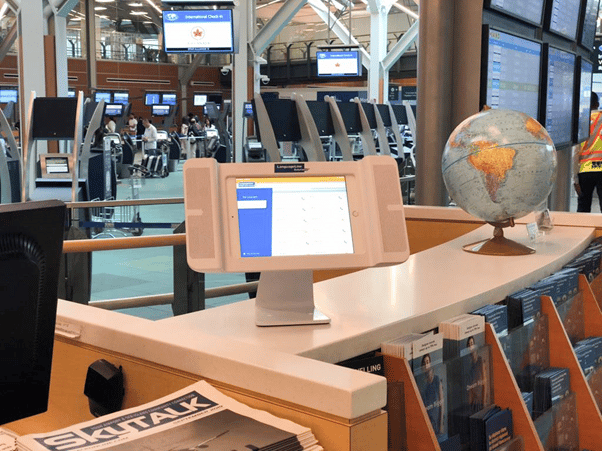
That positioning means the airport handles a steady flow of passengers from across Asia, Europe, and the Americas every day, not only during major events. Its everyday reality already looks like what many other hubs will face for the first time this summer: a passenger base that arrives speaking a wide range of languages and expects to move through the terminal without friction.
That global reach makes language access more than a convenience. It is a core part of how the airport serves its passengers.
Language Access as a Standing Priority
Vancouver International has long treated accessibility as a priority. For several years, its accessibility initiatives have included LanguageLine on-demand phone interpretation in more than 270 languages throughout its terminals.
The airport also offers LanguageLine one-touch, real-time video interpretation in 50 languages, including American Sign Language (ASL) and British Sign Language (BSL). Frontline staff can request the on-demand video remote interpreting (VRI) service whenever a traveler needs it.
Download Our World Cup Readiness Checklist
How Travelers Access the Service
Travelers can access interpretation in two ways. Tablets and access points equipped with LanguageLine video and audio interpretation are located at all main Information Counters, and travelers can also ask any frontline Guest Experience Representative or Customer Care staff member to connect them with an interpreter.
The service provides:
- Audio Interpretation: Telephonic support that interprets conversations with staff instantly with the help of a professional interpreter. This service is available in 270+ languages.
- Video Interpretation: Real-time sign language and spoken-language video assistance for travelers who are Deaf or Hard of Hearing. This service is available in 50 languages, including ASL and BSL.
- Multilingual Materials: Airport maps, brochures, and messaging in both of Canada's official languages, English and French, with additional tourism support available through LanguageLine.
Why It Matters Now
Vancouver International's approach offers a model for any transportation hub facing a wave of international visitors. The airport learned during the 2010 Olympics that language access cannot be improvised when demand spikes.
Vancouver built language access into everyday operations rather than treating it as an add-on. The interpretation tools are already in place, the staff already know how to use them, and travelers already encounter them at the counters where they need help most.
Vancouver International treats language access as standing infrastructure. The airport tests it through daily use and trusts its LanguageLine interpretation solutions to scale when volume rises.
Are You World Cup-Ready?
Download Our World Cup Readiness Checklist
This practical checklist helps transportation hubs and other government organizations evaluate their language access readiness before demand increases.
Inside the free checklist, you'll find:
- Key areas to evaluate before multilingual demand increases
- Guidance for language identification and public communication access
- Recommendations for interpreter access and staff readiness
- Planning considerations for multilingual materials and translation workflows
- Tips for supporting residents and international visitors across public services
- Global events can significantly increase demand for multilingual public services
- Residents and visitors need equitable access to critical information and support
- Staff need fast, reliable access to qualified interpreters and translation tools
- Advance preparation improves operational efficiency and public service delivery during high-demand periods
The importance of acting now:
Help your organization prepare for increased language access and communication needs as World Cup demand spikes. Get the checklist today.