
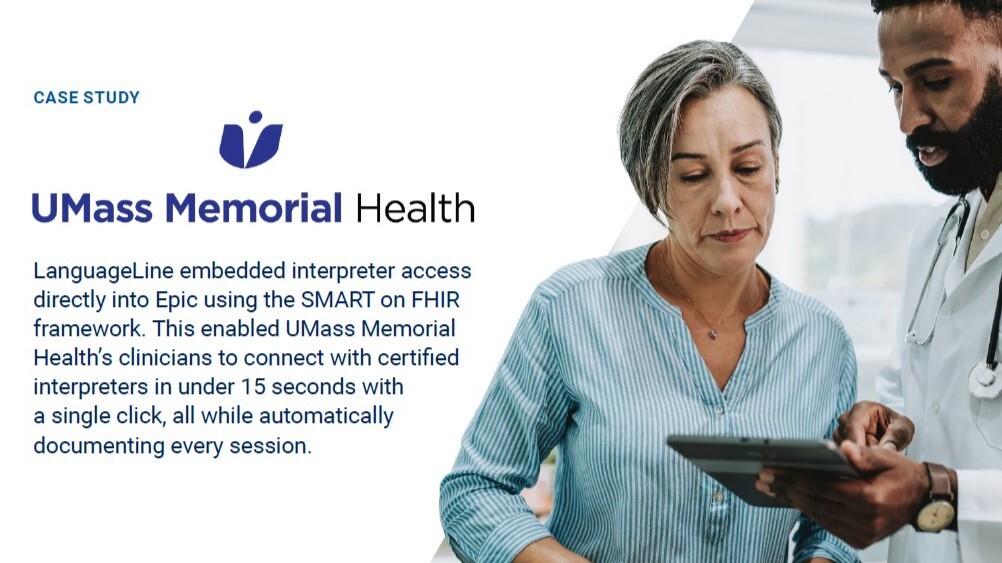
For modern health systems, the challenge isn’t acknowledging the need for interpreter services. It’s ensuring those services are actually utilized at the point of care.
When language access exists outside the Electronic Health Record (EHR), it creates "hidden friction." Extra logins, separate hardware, and manual documentation after the fact become barriers that care teams simply don’t have time to navigate. Over time, this friction leads to lower utilization, increased risk of miscommunication, and added pressure on already overburdened staff.
UMass Memorial Health (UMMH) solved this by moving language access from a "workaround" to a core clinical workflow. Download the Full Case Study
The Solution: Native Epic Integration
LanguageLine partnered with UMass Memorial to embed certified medical interpreters directly into the Epic Haiku, Canto, and Rover applications. Using the SMART on FHIR framework, the team replaced disconnected tools with a seamless, "single-click" solution.
-
Speed to Connection: Interpreters are requested directly from the patient’s chart, with sessions beginning in under 15 seconds.
-
Intelligent Routing: The patient’s preferred language is pulled automatically from their record, eliminating the need for manual selection.
-
Automated Documentation: Key data including session duration, language used, and interpreter ID is automatically written back to clinic notes and flowsheets. This ensures a timely, accurate record for compliance, billing, and Section 1557 audits.
The Result: High Trust and Seamless Adoption
By removing the administrative "tax" on clinicians, UMass Memorial Health transformed language access into a tool clinicians trust and use consistently. With manual documentation eliminated, care teams can focus exclusively on patient outcomes rather than logistics.
Download the Case Study
UMass Memorial Health’s success proves that language access is most effective when it is embedded, not bolted on.
Download the Full Case Study to explore the technical roadmap, adoption strategies, and the measurable impact EHR integration has on clinician morale and patient safety.
This is how technology should work: serving communication, honoring culture, and making it easier for clinicians to deliver great care." — Dr. Eric Alper, Chief Quality Officer and Chief Clinical Informatics Officer, UMass Memorial Health