
Summary:
Can AI translation be trusted for critical communication? AI delivers speed, but human review is vital when accuracy, tone, and cultural nuance matter. A hybrid model—AI for scale, humans for meaning—ensures both speed and trust.
How do top companies scale translation without losing quality? Firms like SS&C Intralinks use flexible workflows that auto-detect language, select the right engine, and send key content to experts. This keeps translation fast and reliable.
What drives long-term success in AI-powered translation? Strong partnerships and constant refinement. Teams adapt quickly to challenges and improve systems together, turning translation into a strategic edge.

Balancing Speed and Trust: The New Standard for AI Translation Accuracy
AI can translate a document in less than a second, but a single mistranslation can unravel a deal, misrepresent a regulation, or send the wrong message entirely.
As machine translation tools grow faster and more sophisticated, so does the pressure to rely on them. Yet speed isn't enough in a world of high-stakes communication where accuracy is everything and tone, cultural nuance, and precision truly matter.
In our recent webinar, "AI Meets Accuracy: The Future of Scalable Language Solutions," we explored how forward-thinking companies are using hybrid AI-human workflows to meet demand without compromising trust, accuracy, or cultural clarity.
Here are three key takeaways from the session.
1. AI Enables Speed - But Humans Ensure Quality and Cultural Accuracy
The software can translate thousands of documents in seconds. But when a misplaced word alters the meaning of a financial statement or a legal clause, the damage isn’t just semantic. It’s material.
That’s the tension facing global organizations racing to keep up with the demands of multilingual communication: speed versus certainty. The consensus from our webinar? There’s no substitute for the human touch.
“AI is fast. But trust requires people,” said Tom Shaw, Translation Solutions Director at LanguageLine.
He described a model where artificial intelligence handles volume, but trained linguists handle meaning, reviewing output for tone, clarity, and cultural appropriateness before it ever reaches a client.
That hybrid approach is already at work inside SS&C Intralinks, which supports high-stakes cross-border M&A deals around the world. Speaking during the webinar, Arjun (AJ) Patel, Director of Global Deal Services, explained how the company uses AI to rapidly process content in over 120 languages. Human experts step in when nuance, formatting, or certification matters most.
“We don’t get to choose between speed and quality,” Patel said. “We have to deliver both."
Learn More: LanguageLine's AI Translation Solutions
2) A Flexible Workflow Is Essential for Real-World Scale
It’s not just about technology. It’s also about the right workflow.
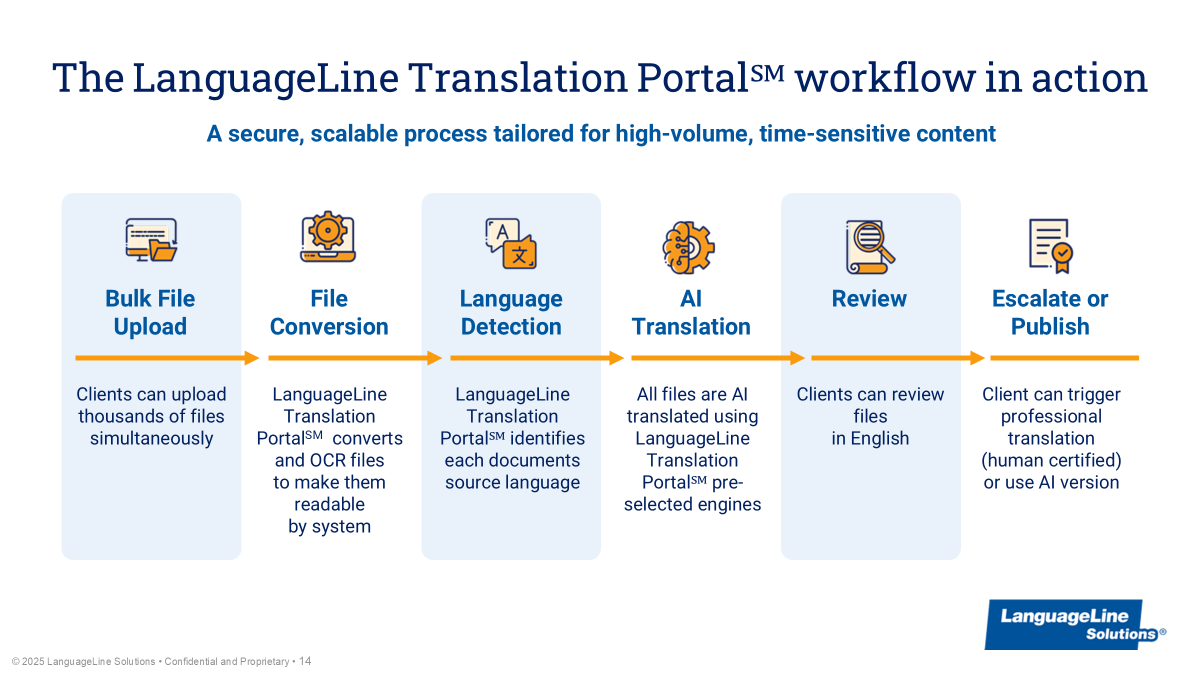
Intralinks’ deal teams often receive files in every imaginable format—PDFs, scanned images, Excel sheets, and even password-protected documents—with no indication of which languages are involved. That complexity makes traditional, linear workflows untenable.
LanguageLine and Intralinks co-developed a dynamic system that automatically detects languages, selects the best-fit translation engine (DeepL, Microsoft, AWS, or custom-trained models), and routes content through configurable paths. If needed, documents are escalated for expert human review, all in a secure, auditable environment.
The result? Translation becomes a frictionless part of the deal workflow, not a bottleneck.
3) Partnership and Continuous Learning Drive Long-Term Success
What set this solution apart wasn’t just the technology. It was the partnership behind it.
Unlike many enterprise tools, this wasn’t a case of plugging in software and moving on. The workflow between LanguageLine and Intralinks was shaped by constant refinement. As new problems surfaced—poor scan quality, obscure file formats, or unexpected language mixes—both teams committed to iterating quickly and communicating openly.
“We weren’t afraid to (try things),” Patel said. “The idea was always: fix it fast, learn from it, and move forward.”
That mindset paid off. Today, translation has become one of Intralinks’ most requested services, helping clients navigate complex deals with greater confidence and less delay. What began as a technical solution has become a competitive edge.
Final Thought
AI is transforming the translation landscape, but it’s not replacing humans. It’s augmenting them. Organizations that adopt a hybrid AI-human model are not only keeping pace with global demand, but they’re also setting a new standard for accuracy, nuance, and efficiency.
If your organization is grappling with multilingual scale, it’s time to rethink translation not just as a task, but as a strategic function that is powered by technology, protected by expertise, and delivered in partnership.
To learn more, please contact your LanguageLine Business Development Manager or email us at translation@languageline.com. Please visit our website to learn more about our AI Translation tools, as well as the full suite of our translation solutions.